
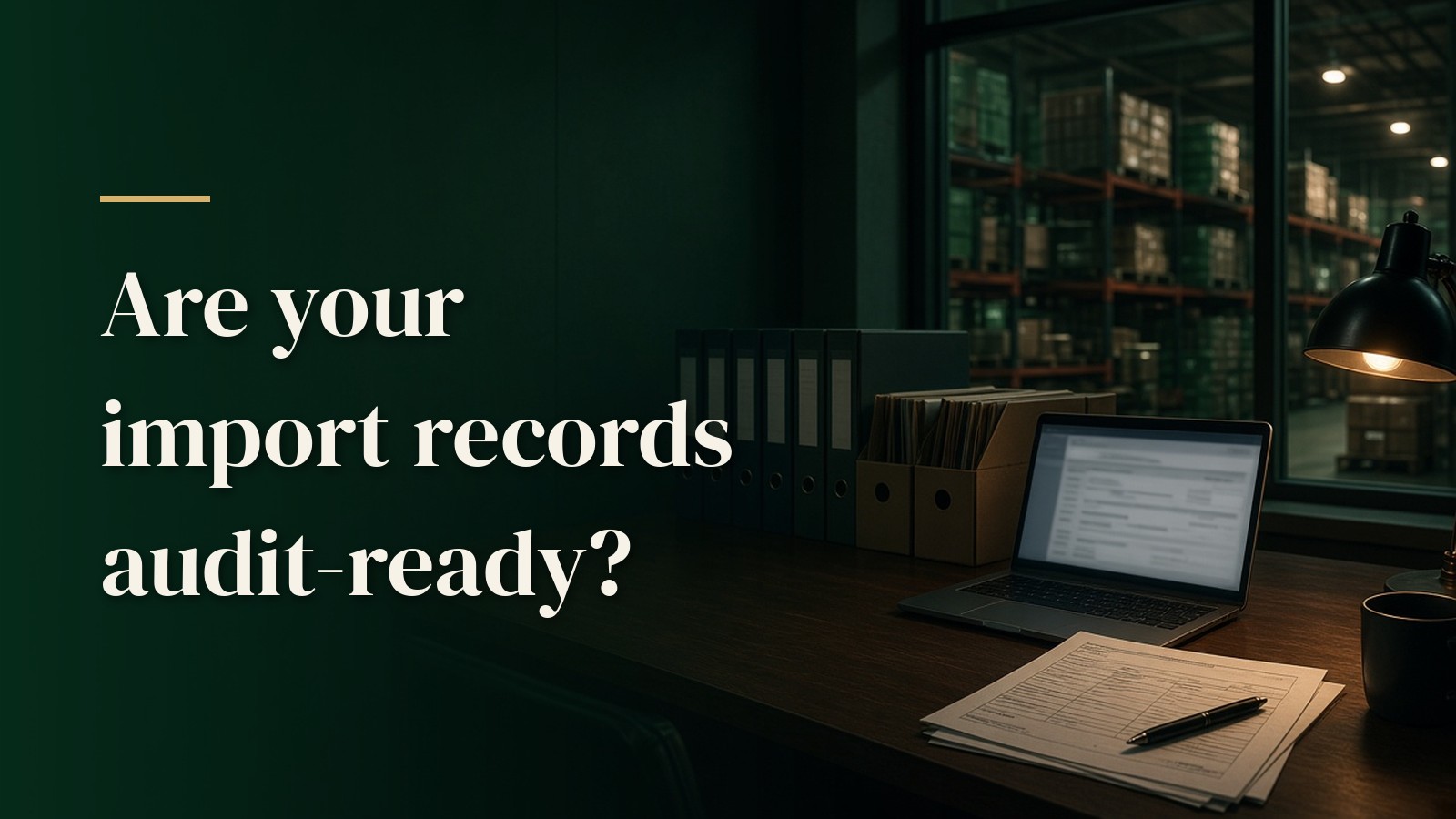
This is for Canadian businesses and non-resident importers (NRIs) bringing in commercial goods, meaning goods for sale or for business use. It explains which import records the Canada Border Services Agency (CBSA) expects you to keep, how long to keep them, where they have to be, and what it costs if you can't produce them when CBSA asks.
The short answer: Keep every record that shows what you bought, where it was made, what you paid, how it was shipped and declared, and what you did with it in Canada. Keep it for six years after the goods are imported, at your place of business in Canada or at another location CBSA has approved. The CARM Client Portal is not a record-keeping system, and your customs broker's copies don't count as your records unless CBSA has approved the broker as your records keeper. If CBSA finds you haven't kept the required records, it can assess a flat $25,000 penalty per audit, and it can deny the duty-free treatment you claimed under a trade agreement such as CUSMA.
Quick checklist
- Keep a full file for every shipment (the list is below) for six years after the import date.
- Keep it in Canada, at your place of business. If the records will be kept anywhere else in Canada (your accountant or your broker, for example) or in the United States or Mexico (the only places outside Canada CBSA will approve), get CBSA's approval first through the Agreement to Maintain Records Elsewhere than the Place of Business in Canada (form BSF900) in the CARM Client Portal.
- Don't rely on CARM as your archive, or on your broker unless CBSA has approved it as your records keeper. CBSA says the CARM Client Portal is not to be used for record keeping.
- Scanning is fine, if it's done properly. Electronic records must be readable on demand and traceable to the source documents. Scans must follow the national standard CAN/CGSB-72.34-2017. If you don't meet it, keep the paper.
- Keep the extra proof for special rates. That means your origin certifications, end-use certificates for goods released duty-free or at a reduced rate because of how they'll be used, and the paperwork behind any surtax remission claim.
- Be able to explain the file. CBSA can ask questions about your records as well as for copies, and you must answer truthfully.
- Watch the 90-day clock. If a record shows an earlier entry was wrong, you generally have 90 days to correct it.
What to keep for each shipment
The Imported Goods Records Regulations require records that relate to four things. Here is what that usually means in practice:
- Origin, marking, purchase, importation, cost and value of the goods. This includes the purchase order and contract, the commercial invoice, and any supplier credit notes or price adjustments. Keep the CUSMA certification of origin or other proof of origin and the supplier documents behind it. Keep freight, insurance and other cost invoices, and support for anything added to the value, such as royalties, assists or commissions. Keep the bill of lading or other transport documents, permits, and your accounting declaration (CAD, or B3 for older entries) with any CBSA statements.
- Payment for the goods. This means proof of what you actually paid the supplier: bank records, wire confirmations and statements.
- The sale or other disposal of the goods in Canada. Sales invoices, or records showing the goods were used in your business, scrapped or exported.
- Any advance ruling you applied for on those goods.
There are extra rules for some importers. If goods came in free or at a reduced rate because of how they would be used (or who would use them), you also keep a certificate or other record from the user showing the actual use. If the goods were later diverted to another use, you keep proof that the full duties were paid. Customs Self Assessment (CSA) importers have an added list. Licensed sufferance and bonded warehouses, duty-free shops and holders of a duties relief certificate have their own lists, with six-year periods that start from different events.
It also helps to keep your classification and valuation reasoning, such as product spec sheets or a note explaining why a tariff item was chosen. That makes it much easier to answer an officer's questions years later. For goods bought from a related company, also keep your transfer-pricing documents. Our related-party imports guide explains why.
How long: six years, sometimes longer
- CBSA: six years following the importation of the goods.
- CRA (GST/HST): generally six years from the end of the year the records relate to. Your import GST input tax credits depend on these same documents.
- In practice: keep each file until both clocks have run out. Keep anything tied to an open objection, appeal or adjustment until that matter is settled.
Why six years matters: CBSA can generally re-determine the origin, tariff classification or value for duty of goods within four years of the original determination. Unless an officer has already made a determination, the law treats the determination as made when you account for the goods (Customs Act s. 58(2)). Your own duty to correct a wrong declaration also runs for four years after accounting. The records are your evidence for that whole window.
Where the records have to be
- Default: at your place of business in Canada. PO boxes and mail-forwarding services are not accepted as a business address.
- Somewhere else in Canada (your accountant's office or your customs broker's office, for example): you need CBSA's approval through the CARM Client Portal.
- Non-resident importers: you have the same record-keeping obligations as a Canadian importer. You can ask CBSA to let a licensed customs broker, an accountant or another agent keep the records in Canada for you. You can also ask to keep them in the United States or Mexico. Records on a U.S. or Mexican server are not "records in Canada", but CBSA may accept a copy if you make it available in Canada in a readable electronic format. See our non-resident importer service.
- Even with approval, you are still responsible. CBSA's D-memo is clear that when an agent keeps the records, the importer still carries the legal obligation. Keep CBSA's approval letter in your file.
New importers complete the BSF900 when they register their import-export account in CARM. Importers who registered before CARM need to add a Books and Records address to their CARM profile. Not set up in CARM yet? You fill out the CARM form on our CARM page, our team sets up your CARM Client Portal account on your behalf, and we transfer the login information to you when it's done. The fee is $200.
What CBSA asks for, and what happens if you can't produce it
CBSA checks records in a few ways:
- Trade compliance verifications usually look at all your imports over a period of time, normally one year, and are often done well after the goods arrived. CBSA's current priority list includes the U.S. surtax orders, steel and aluminum surtaxes, CUSMA origin in the automotive sector, and GST exemption codes.
- Compliance validation letters ask for more information about specific entries, and you must reply within 30 days. Directed compliance letters come with a bill already attached.
If the records aren't there, it costs you:
| Problem | AMPS contravention | Penalty |
|---|---|---|
| Didn't keep the required records, in the required place and manner, for the required time | C299 | $25,000 flat, per audit |
| Didn't make records available when CBSA asked in writing | C157 | $600, then $1,200, then $2,400 per written request |
| Electronic records not kept in a readable format | C001 | $150, then $225, then $450 per verification |
AMPS is the Administrative Monetary Penalty System, CBSA's system of civil fines. On top of the penalties, CBSA can deny or withdraw preferential tariff treatment (for example, CUSMA duty-free) on goods you can't support with records, and then bill the duty and interest. If you still don't comply after CBSA formally asks you to fix your record keeping, it can also hold goods you import until you do.
Where a customs broker takes work off your hands
You stay responsible for your records, but a broker can do a lot of the work behind them. A broker can:
- give you copies of the customs declarations it files for you, so the customs side of each shipment file is complete
- flag missing or weak origin documents before you claim CUSMA or another trade agreement rate
- prepare corrections when a supplier credit note or a new record shows an entry was wrong
- help you pull together and explain files when a compliance letter or verification arrives
Our import customs brokerage service can help with this for regular importers. If you're unsure who carries the liability on your shipments, see Importer of Record in Canada.
FAQ
How long do I have to keep import records in Canada?
Six years after the goods are imported, for CBSA. CRA's six-year rule for GST/HST runs from the end of the year the records relate to, so keep each file until both have passed. CBSA's six years count from each import date; CRA's count from the end of the year.
My broker has copies of everything. Isn't that enough?
No. The legal duty is yours. A broker or accountant can keep your records for you only with CBSA's approval of a BSF900 agreement, and even then you remain responsible.
Can I just use the CARM Client Portal as my record system?
No. CBSA says the CARM Client Portal is not to be used for record keeping. Keep your own complete files.
We're a U.S. company importing into Canada. Can we keep records at our U.S. office?
Yes, if CBSA approves it through the CARM Client Portal. You must be able to make the records available in Canada, or wherever CBSA designates, in a readable format.
Can we scan our documents and throw the paper away?
Yes, if your imaging follows CAN/CGSB-72.34-2017 and your system can produce readable copies linked to the source documents. If you don't meet that standard, keep the paper originals.
What does CBSA do if we can't find old records?
It can charge a $25,000 penalty per audit for not keeping them. It can also charge escalating penalties for not producing them on request, deny duty-free treatment you claimed and bill the duty, and, if you don't fix things after a formal request, hold future shipments until you do.
We found a mistake on an entry from two years ago. What now?
If you have specific information that a declaration of origin, tariff classification or value was wrong, you generally have 90 days to correct it. The duty to correct lasts four years after the goods were accounted for. Talk to your broker about filing the correction.
Technical detail and sources
- Customs Act, s. 40: duty to keep records at your place of business in Canada or a place the Minister designates, make them available and answer truthfully. s. 43: CBSA can require records to be produced. s. 58(2): determination deemed made when goods are accounted for. s. 59: four-year re-determination window. s. 41: detention of goods after a request to comply. s. 32.2: 90-day correction duty, ending four years after accounting.
- Imported Goods Records Regulations, SOR/86-1011: s. 2 (six years; origin, marking, purchase, importation, costs, value, payment, sale or disposal, advance rulings), s. 2(2) (CSA importers), s. 3 (end-use and diversion records), s. 3.1 (sufferance and bonded warehouses, duty-free shops, duties relief certificate holders), ss. 4–6 (audit-ready, imaged and electronic records), ss. 7–8 (preferential tariff treatment may be denied or withdrawn; the text still names NAFTA, CCFTA and CCRFTA). CBSA states the denial rule generally for preferential tariff treatment in D17-1-21 para 24, and the Customs Tariff, s. 24(1) makes proof of origin a condition of any preferential rate.
- CBSA Memorandum D17-1-21, Maintenance of Records in Canada by Importers (May 2024): place of business, non-resident importers, BSF900 through the CARM Client Portal, U.S./Mexico locations, CAN/CGSB-72.34-2017, CARM not to be used for record keeping, non-compliance (AMPS, cancelled agreement, detention under s. 41).
- Form BSF900: Agreement to Maintain Records Elsewhere than the Place of Business in Canada.
- CBSA Memorandum D11-6-6: 90-day correction period from reason to believe, and the obligation ending four years after accounting (Customs Act s. 32.2).
- CBSA trade compliance verification (priorities updated October 2026): verification priorities, compliance validation letters (30 days) and directed compliance letters.
- AMPS: C299, C157, C001.
- CRA: GST/HST records to keep and Where to keep your records and for how long.
Want your import files audit-ready before CBSA asks? J.W. Smith Customs Broker Ltd is a family-owned licensed customs broker in Brampton, in business since 1974, with over a million shipments cleared. Request a quote or call (905) 542-7327.
Need Help with Customs?
J.W. Smith Customs Brokers has over 50 years of experience helping Canadian businesses navigate imports with confidence. Our team of licensed customs brokers is ready to assist with your import and export needs.
Buying Cargo, Utility or Semi-Trailers for Your Business? Check the Landed Cost First
Nov 12, 2026

Canadian Trailer Manufacturers: Which Tariffs Hit Parts Imports and U.S. Exports?
Nov 10, 2026
Related-Party Imports: How CBSA Values Goods From Your Parent or Affiliate
Nov 5, 2026
Customs Broker Power of Attorney in Canada
Nov 3, 2026