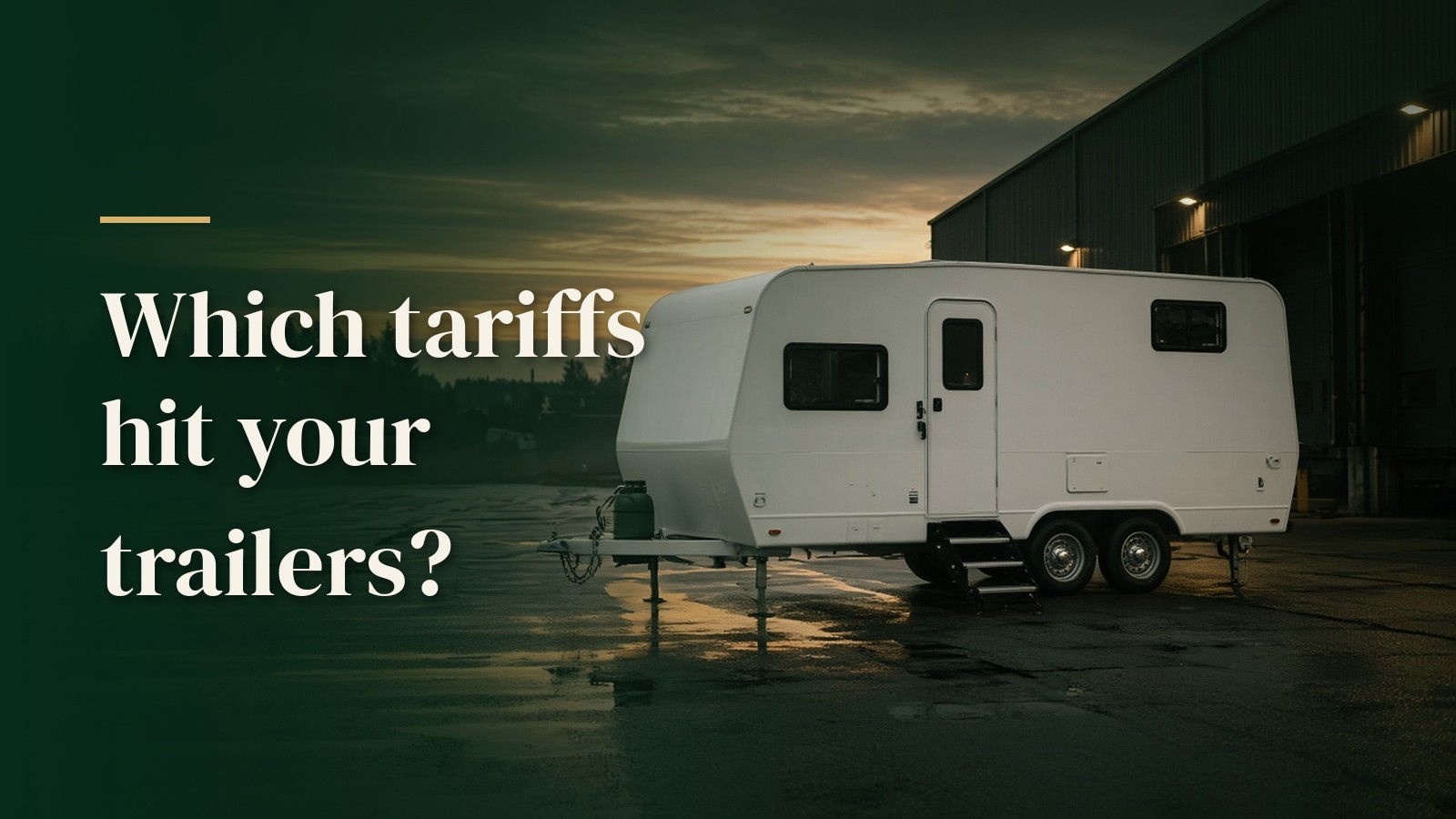
If you build commercial trailers or semi-trailers in Canada, two borders can change your cost: bringing U.S. parts or finished units into Canada, and selling Canadian-built trailers into the United States. This is for plant purchasing and logistics teams at commercial trailer builders—not personal travel-trailer or RV buyers. RV travel trailers are not part of the U.S. van-type antidumping case described below, which covers large enclosed freight vans (dry or refrigerated) over 26,000 lb GVWR; RVs can still face other U.S. charges, such as Section 232.
In plain terms: Canada may add a surtax (an extra charge, set as a percentage of the goods' value for duty and paid on top of regular duty) on some U.S.-origin goods. The United States may add a Section 232 duty (a U.S. national-security tariff on steel, aluminum and copper, and on listed products made from them) on many trailers, and—for some van-type trailers—an antidumping cash deposit (an up-front deposit of estimated antidumping duty that the U.S. importer pays at entry; the amount actually owed is settled later and can go up, go down, or be refunded). Not every part and not every trailer pays the same. Classification and the written rules control. Budget 2026 did not create a new trailer-specific Canadian duty; treat the measures below as the current baseline until an order changes.
Bringing parts into Canada
Finished U.S. trailers vs trailer parts
Do not mix these up on your bill of materials.
Finished U.S.-origin trailers and semi-trailers in the Canadian items for those finished units (8716.39.10 / .20 / .30 / .90) are on Schedule 2 of Canada's United States Surtax Order (2026). That usually means a 25% surtax on value for duty for goods that originate in the United States under the marking-origin rules—on top of any regular customs duty.
Trailer parts classified under heading 8716.90 are not on those surtax schedules in the current consolidation (current to October 19, 2026). So those 8716.90 lines themselves do not attract that September 8 U.S. surtax. That is different from importing a finished unit under 8716.39.*.
Still check every line:
- A part can sit under another heading that is scheduled. For example, 8302.10.00 (base-metal hinges) is on Schedule 2 at 25%. That does not mean every hinge, axle, lamp, landing gear, steel sheet, or aluminum input is scheduled. Classification drives the surtax, not the words "trailer part" on the purchase order. Check each BOM line against Schedules 1–3.
- Surtax follows U.S. origin under the marking rules—not merely shipping from a U.S. warehouse.
- Regular duty is separate. Goods that may qualify for CUSMA preferential treatment can enter free of regular duty when origin is properly claimed and supported; that does not erase a surtax that applies.
If surtax applies—and when manufacturing relief may help
Your entry needs the right surtax code and amount (Schedule 1 = 15%, Schedule 2 = 25%, Schedule 3 = 50%). Surtax sits on value for duty; GST is calculated on a tax base that includes it. Goods in transit to Canada on September 8, 2026 (bound for Canada and under a carrier's control) are excepted; keep proof such as the bill of lading or cargo control documents.
If a listed U.S.-origin input is imported for use in Canada in the manufacture or processing of any good, section 3 of the United States Surtax Remission Order (2025), as amended, can remit the surtax—subject to section 5 (including that no other surtax relief was granted for the same good, and a claim within two years after importation). That path is different from a Finance remission request. Relief is not automatic for every BOM line. See US Surtax Remission.
Before you ship inbound
- Split finished trailers from parts (and other headings); confirm classification.
- Check each U.S.-origin line against Schedules 1–3—do not trust a supplier "no tariff" note.
- If surtax applies, use the correct CAD code/amount; account in CARM on time.
- Claim CUSMA preferential duty only when origin and documents support it.
- For listed manufacturing inputs, assess a section 3 claim (section 5 + two-year deadline) before treating surtax as sunk cost.
For clearance support, see Import into Canada or request an estimate.
Selling finished trailers to the U.S.
U.S. charges apply when goods enter the United States. The U.S. importer of record (often the dealer or end customer; sometimes you as a non-resident importer) posts deposits and pays applicable duties. Canadian paperwork still has to match the U.S. declaration.
Section 232 metal-derivative duty (many trailers)
For many goods-transport trailers and certain parts listed as steel or aluminum derivatives, the U.S. can charge an extra Section 232 duty on the full customs value of the product—regardless of how much metal it contains, and not just on the value of its metal content—for entries on or after April 6, 2026. The governing proclamations were updated again effective June 8, 2026 (modified annex lists and related conditions). Listed goods-transport trailers and certain trailer parts remain on that full-value list as modified.
The usual listed rate is 25%. A 10% path can apply only when aluminum, steel, or copper content meets a strict "entirely U.S." metal-origin test. Since June 8, 2026, that test is met only if the relevant U.S.-origin metal is at least 85% of the product's metal weight. For a mixed-metal trailer, that is a metal- and weight-specific calculation—not "any U.S. metal qualifies." Eligibility, mill or melt/pour records, and CBP reporting are fact-sensitive. Have the U.S. importer's broker verify current notes before you bake 10% into a quote. Any estimate here is non-binding.
Practical takeaway: model Section 232 on declared value unless a reduced-rate path has been verified.
Antidumping cash deposits (some van-type trailers only)
Separately, the U.S. has a preliminary antidumping case on certain van-type trailers and listed subassemblies from Canada. Since August 4, 2026, CBP has collected cash deposits at preliminary rates for subject entries. Those rates are not final duties and can change. Manac (the only company Commerce individually examined), three other named Canadian producers, and "all others" are at 4.29%; two named companies that did not respond to Commerce are at 44.86%. The rate depends on the exporter and producer named in the notice.
This is not "all trailers." Covered van-type trailers are trailers for carrying goods—typically fully enclosed dry or refrigerated vans towed by a truck tractor—with a gross vehicle weight rating greater than 26,000 pounds that match the written description. RV travel trailers and camping trailers do not fit that description. Listed subassemblies (subframes, walls and roofs, doors, running gear, landing gear, and others) can also be in. Ordinary flatbeds and tankers are not pulled in merely because a tariff code overlaps. Do not rely on a sales label such as "utility" or "specialty," and do not assume a component on the same bill of lading as a covered trailer is out. Map the actual unit and shipment to the written scope.
Commerce's final decision is due no later than 135 days after August 4, 2026. A public fact sheet pointed to around December 16, 2026—an estimate only. An affirmative Commerce final still needs an ITC injury finding before an antidumping order. Canada's related CVD petition was withdrawn; there is no concurrent Canada CVD deposit from that petition. Chinese kits routed through Canada can raise separate third-country issues—flag BOM origin early.
Before you ship outbound
- Confirm van-type antidumping scope (or listed subassembly) vs out of scope for each model.
- Identify the exporter/producer name for the deposit rate.
- Model Section 232 plus any antidumping deposit—do not net them without broker or counsel review.
- Align invoices, classification, value, serials, GVWR, and build specs with the U.S. entry.
- Canadian-side export docs: Export to the USA.
Quick answers
Do all U.S. trailer parts pay Canada's 25% surtax? No. Finished listed trailers often do. Parts classified under 8716.90 do not—but a part that classifies under a different, scheduled heading still can.
Does CUSMA wipe out the Canadian surtax? No. Goods that qualify for CUSMA preference may enter free of regular duty; the surtax is separate when it applies.
Does every Canadian trailer exported to the U.S. need the 4.29% deposit? No. Only merchandise in the written van-type scope (including the GVWR threshold and listed subassemblies). RV travel trailers are not in this case. Rates vary by exporter and producer.
Do Section 232 and antidumping stack? They are different measures. For a covered van-type trailer, U.S. modeling often needs both unless a verified exclusion or reduced-rate path applies.
Who pays? In Canada, the importer of record accounts for duty, surtax, and GST (usually through CARM). In the U.S., the U.S. importer of record posts antidumping deposits and pays applicable Section 232 and other duties. J.W. Smith clears Canadian imports and can help with Canadian export documents; we do not replace your U.S. customs broker for U.S. entry.
Technical detail and sources
Instrument names, codes, and the rate chart live here. Prefer the Federal Register notice over a Commerce fact sheet when they disagree on the Canada case number (A-122-875 controls; a fact sheet table that reads A-122-873 does not).
Canada inbound: SOR/2026-186 (Schedule 2: 8716.39.10/.20/.30/.90 at 25%); CN 26-23 (CAD codes 26186A/B/C, field 85); Customs Tariff Ch. 87 and Ch. 83 (8302.10.00 hinge example); SOR/2025-122 ss. 3 and 5, as amended by SOR/2026-186.
U.S. outbound: Proclamation 11021 (full value from April 6, 2026) as modified by Proclamation 11032 (effective June 8, 2026); Annex I-B (includes 8716.39.00 and 8716.90.50); preliminary LTFV notice (91 FR 49407, Aug. 4, 2026, A-122-875—Appendix I scope; final ≤135 days after Aug. 4; ITC before the later of 120 days after the prelim or 45 days after Commerce final; preliminary deposits: Manac / Di-Mond / Innovative Trailer Design / Morgan Canada / All Others 4.29%; Collins / GINCOR Werx 44.86% AFA); CVD terminated (C-122-876); Commerce fact sheet (July 30, 2026 summary only). Related: US Surtax Remission.
Canadian trailer manufacturers moving U.S. components in—or finished units south—need classification and documents that match the actual schedule or written scope, not a one-rate rumour. J.W. Smith Customs Broker Ltd is a family-owned licensed customs broker in Brampton, serving commercial importers since 1974 with over a million shipments cleared. We handle Canadian import clearance, classification support and CARM accounting for inbound parts, and U.S. export documentation when that is part of your file. Request a quote or call (905) 542-7327.
Need Help with Customs?
J.W. Smith Customs Brokers has over 50 years of experience helping Canadian businesses navigate imports with confidence. Our team of licensed customs brokers is ready to assist with your import and export needs.
Related-Party Imports: How CBSA Values Goods From Your Parent or Affiliate
Nov 5, 2026

Customs Broker Power of Attorney in Canada
Nov 3, 2026
US Surtax Remission: Can Your Business Skip or Recover the Surtax?
Oct 30, 2026
U.S. Section 338 escalates: Sep 15 list changes, Sep 29 import bans for listed Canadian goods
Sep 15, 2026