Wednesday’s 50% U.S. tariff: what Canadian exporters actually need to know
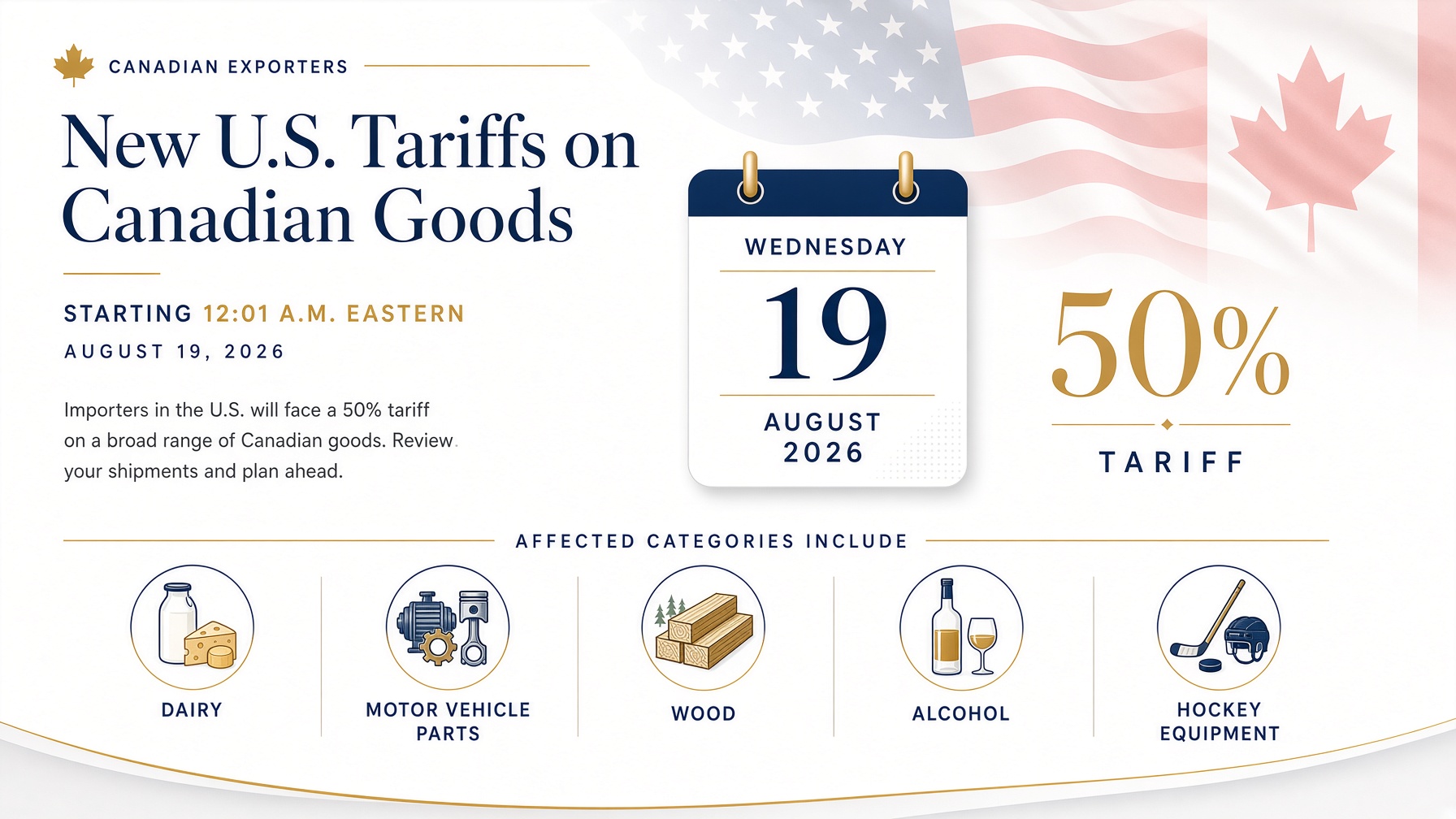
If you ship into the United States, the clock that matters is 12:01 a.m. Eastern on Wednesday, August 19, 2026.
That is when a new 50% U.S. duty starts on a long list of Canadian goods. It is extra. It sits on top of whatever duty already applies. And CUSMA will not get you out of it.
Talks are still going on in Washington as of Monday. They may still move. Until a White House proclamation actually changes the date, plan as if Wednesday holds.
What this is
On July 20, President Trump signed three proclamations under Section 338 of the Tariff Act of 1930. That law has been on the books for almost a century. This is the first time a U.S. president has used it to put tariffs on another country.
The three proclamations are titled dairy, motor vehicles, and alcoholic beverages. Those titles are the political story. The product lists are the commercial one, and they do not match the names.
The White House’s own fact sheet says the lists run from wine to hockey sticks to cement.
The extra duty is 50% of the U.S. customs value. If a covered shipment is worth $10,000 at the border, that is another $5,000 in U.S. duty, before the regular tariff, before merchandise processing, before anything else your U.S. customer already pays.
There is no cheaper second rate. There is no published end date. The President can change, widen, or drop the lists later. Until that happens, this is the rule.
The date that actually counts
The tariff applies to goods entered for consumption, or withdrawn from a U.S. warehouse for consumption, on or after 12:01 a.m. Eastern on August 19.
Not the order date. Not the invoice date. Not the day the truck left Brampton.
If it ships Monday and U.S. Customs does not accept the entry until Wednesday morning, it is in.
There is no general “already on the water” exception in the proclamations. In-transit goods are not automatically safe.
If you have freight sitting in a U.S. bonded warehouse, pulling it out on or after Wednesday is the same as a new entry.
CUSMA does not save covered goods
If your product is on one of the three lists, a valid CUSMA / USMCA claim does not turn the 50% off.
You may still want the CUSMA claim for the regular duty. That is a separate question. The Section 338 surcharge applies either way.
The lists are wider than the titles
Do not decide you are fine because you do not make cars, cheese, or whisky. And do not assume you are hit just because the title sounds like you.
The dairy proclamation covers 52 U.S. tariff lines. Cheese headings are not on the official annex. What is on it: milk powders, whey, casein, lactose and other syrups, bakery mixes with a lot of butterfat, non-alcoholic beer, hops, and peppermint oil.
The motor vehicles proclamation is the big list, about 439 lines. Finished cars and auto parts are not on it. They already sit under a different U.S. tariff (Section 232). What is on this list is almost everything the title does not suggest: Portland cement, wood and plywood, paper, furniture, electronics, textiles, plastics, leather goods, and motorcycles over 800 cc.
The alcohol proclamation covers 63 lines. Beer, wine, and spirits are on it. So are some products that have nothing to do with a liquor store, including hockey equipment, grapefruit oil, wooden kitchenware, and certain papers.
Trade lawyers who have added up the U.S. import numbers put the covered trade at about $20 billion in a recent year, roughly 5% of what the U.S. buys from us. Some Canadian estimates run higher. Either way, this is a slice of the trade, not everything.
The only way to know if your SKU is in is to match the 8-digit U.S. tariff number (HTSUS) to the official annex. Product descriptions in the annex are for convenience. The code is what counts.
If you are not sure of the U.S. number, do not guess from the Canadian one. They are close cousins, not twins.
What is carved out
Two different kinds of “out.”
The proclamations themselves carve out goods already paying Section 232 duties (steel, aluminum, copper, passenger vehicles and parts, heavy trucks, wood, semiconductors, patented pharmaceuticals, and the rest of that 232 list) and civil aircraft and qualifying parts that meet the WTO civil aircraft note in the U.S. tariff (General Note 6). Those have their own U.S. tariff headings so a broker can actually file them that way.
The White House fact sheet also says energy, potash, fish, and critical minerals are not in this action. Those products are not on the three annex lists. They do not get a special heading. They are out because they were never listed.
If your product is already paying a Section 232 duty, this 50% is not stacked on top of that 232 duty. That does not mean you are in the clear. It means you are in a different U.S. tariff fight.
Personal goods in accompanied baggage are also left out.
Why Washington says it is doing this
The U.S. argument is that Canada treats American goods worse than it treats the same goods from other countries.
Three files sit under that claim.
Canada’s 25% surtax on U.S. motor vehicles, in place since April 2025, does not apply to cars from other countries. The proclamations say U.S. vehicle exports to Canada fell about 22% (about $5.6 billion) from April 2025 through March 2026 compared with the year before.
Most provinces and territories stopped buying or selling U.S. alcohol after the 2025 tariff fight. Alberta and Saskatchewan later lifted their bans. The proclamations say U.S. alcohol exports to Canada dropped about 81% (about $581 million) from March 2025 through February 2026.
On dairy, Washington says Canada’s cheese quotas for the United States do not let retailers apply, while the quotas Canada gives the European Union under CETA do.
You do not have to agree with any of that for the duty to apply. U.S. Customs will collect it on the entry.
What to do this week
Pull the U.S. tariff number for every SKU you ship south. Match it to the annex. Yes or no. Do not go by the proclamation title.
Talk to the U.S. importer of record and their U.S. broker. They are the ones who file the entry and pay the duty. If they have not priced this in, Wednesday morning will be an ugly conversation.
U.S. Customs had not published a Section 338 cargo-systems message as of Monday. The proclamations are still the rule. Brokers should watch for a CSMS, but do not wait for one to decide whether you are on the list.
If a shipment can honestly enter before 12:01 a.m. Eastern on Wednesday, that is the only timing play in the proclamations. “It left Canada on Tuesday” is not a play.
If it will miss the cut, tell the customer now. A 50% surprise on a landed-cost quote is how accounts get lost.
If you hold stock in a U.S. warehouse, decide before Wednesday whether you are withdrawing it.
Watch Wednesday morning. Ottawa and Washington are still talking. As of Monday they were not close enough for anyone to take the proclamations down. If that changes, it will show up as a new presidential action, not a rumour.
A last practical note
This is a U.S. import duty on Canadian goods. Your Canadian B3 / CAD does not collect it. Your U.S. customer’s entry does.
That is why the first phone call is usually the U.S. broker, not CBSA.
If you want a second set of eyes on whether a classification sits on the annex, send us the U.S. tariff number and a plain description of the goods. We will tell you what the list actually says.
Written August 17, 2026, for Canadian exporters. The start date is still 12:01 a.m. Eastern, August 19, 2026, unless the White House changes the proclamations.
Need Help with Customs?
J.W. Smith Customs Brokers has over 50 years of experience helping Canadian businesses navigate imports with confidence. Our team of licensed customs brokers is ready to assist with your import and export needs.